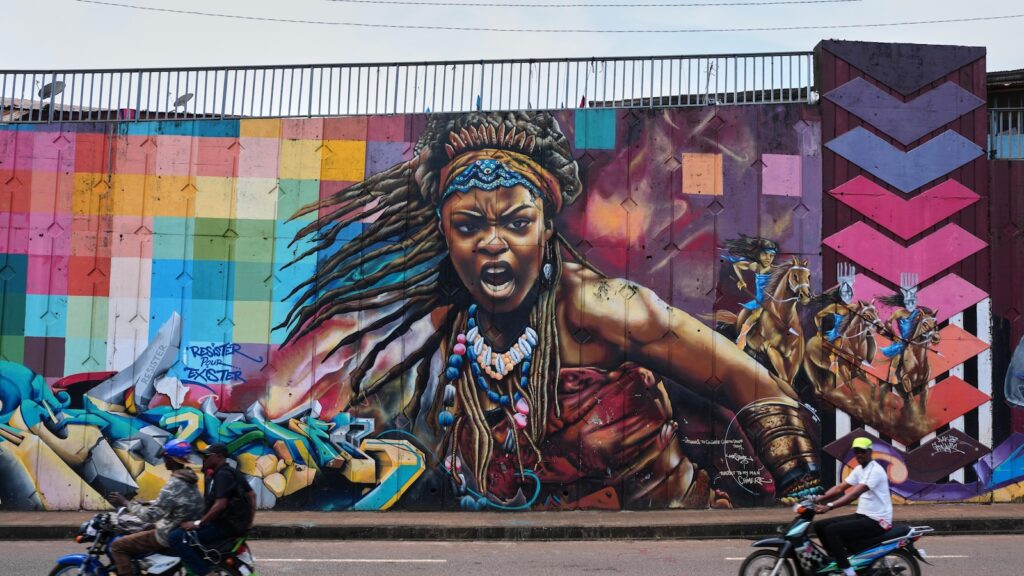
CONAKRY, Guinea– It was the center of the day when Omar Diaw, recognized by his musician name “Chimere”– French for chimera– came close to an empty wall surface off the primary road in Guinea‘s funding and began spray-painting.
” They recognize that I am,” he stated with confidence. Though it had not been clear that “they” were, private citizens and cops really did not bat an eye as Diaw’s other musicians unloaded lots of paint containers onto the roadside in Conakry.
Graffiti has actually flourished for many years in Diaw’s indigenous Senegal, where the contemporary city road art initially removed in West Africa. However when he transferred to Guinea in 2018 to discover a brand-new location, he stated such art was almost missing.
” It was believed that graffiti was criminal damage,” he stated.
To gain the general public, Diaw took a mild technique, utilizing graffiti for public understanding projects. Among his very first was to increase understanding concerning COVID-19 safety nets.
” We needed to attract the populace,” he stated.
The port city of Conakry encounters fast urbanization. Diaw’s graffiti has actually ended up being an indisputable component of its jampacked, concrete-heavy landscape.
His epic pictures of well-known Guinean artists and African self-reliance leaders currently tower over the overloaded vehicles that drive by. Drying out washing hung over the picture of the West African resistance boxer Samory Toure.
The tag of Diaw’s graffiti cumulative, Guinea Ghetto Graff, gets on murals around the city.
Graffiti as it’s recognized today started in the 1960s and ’70s in the USA. It showed up in West Africa through Dakar, Senegal, in 1988, when the area’s very first graffiti musician, Amadou Lamine Ngom, began paint on the city’s wall surfaces.
Recognized by his musician name, “Docta,” Ngom and a team of other musicians was appointed the list below year to repaint murals for an understanding project focused on tidying up Dakar’s roads.
Ngom, 51, stated that at the start, other than such projects, he did graffiti primarily during the night. He later on transformed his technique.
” I chose to do it in wide daytime,” he stated. “So as not to duplicate what’s taking place in the USA, Europe or in other places. To produce graffiti that looks like the African fact, thinking about our fact, our worths.”
Ngom, that later on mentored the adolescent Diaw, stated areas expanded to appreciate the general public art work considering that it showed their lives and experiences.
With the general public’s support, “the authorities really did not have an option,” Ngom stated.
Nowadays, graffiti has actually expanded even more assertive in Senegal, entering into the political messaging around anti-government protests. In Guinea, Diaw’s graffiti has actually attended to problems like migration.
Diaw stated Conakry’s guv sustains a lot of his job and has actually offered him carte blanche to do it any place he desires.
As his most current job close to the road materialized, passersby started to quit and appreciate the picture of Guinea’s armed forces leader, Gen. Mamadi Doumbouya, that took power in a 2021 coup.
A 22-year-old motorist, Ousmane Sylla, stated he was currently accustomed to Diaw’s enormous paints near Conakry’s flight terminal.
” It advises us of old Guinean artists. It advises us of background,” he stated. “Graffiti benefits Africa, it benefits this nation, it benefits every person. I like it, and it transformed the face of our city.”
The following action may be generating a broader series of musicians.
” I would truly such as to see even more females end up being a component of this, since they state that (graffiti) is for guys,” stated Mom Aissata Camara, an uncommon one on Guinea’s graffiti scene.
.