Researchers have actually uncovered 2 brand-new types of old parasitical fungis protected in brownish-yellow going back 99 million years.
The fungis were outgrowing the bodies of host bugs that came to be caught in chunks of brownish-yellow throughout the mid-Cretaceous duration, according to a paper released last month in the Proceedings of the Royal Society B.
” It’s interesting to see a few of the unfamiliarity of the environment that we see today was likewise existing at the elevation of the age of the dinosaurs,” claimed Edmund Jarzembowski, a paleoentomologist at the Nanjing Institute of Geology and Palaeontology and co-author of the research, in a statement.
The types of fungis that were outgrowing the body of a young ant in its cocoon phase was called Paleoophiocordyceps gerontoformicae, while one more types located breaking from the body of an old fly was called Paleoophiocordyceps ironomyiae.
Entomopathogenic fungis can contaminate a variety of insect teams, consisting of ants, flies, crawlers, cicadas and beetles, researchers claim.
The exploration stands for the oldest-known instances of parasitical fungis that contaminate bugs, the scientists claimed. Throughout their 400 million years of conjunction, fungis have actually confirmed to be an essential regulatory authority of insect populaces.
” As the infections are deadly, Ophiocordyceps most likely played an essential function in managing the populaces of bugs by the Mid-Cretaceous, in a comparable means to just how their living equivalents do today,” Jarzembowski claimed.
Little is understood about old entomopathogenic fungis because of the deficiency of fossils that show regular pathogenic frameworks on their hosts, according to the paper.
The freshly uncovered types of fungis shared usual characteristics with contemporary types of Ophiocordyceps, a team of fungis which contains the zombie-ant fungi Ophiocordyceps unilateralis, according to the paper. The teams might have split from each various other regarding 130 million years back, throughout the very early Cretaceous duration, the scientists claimed.

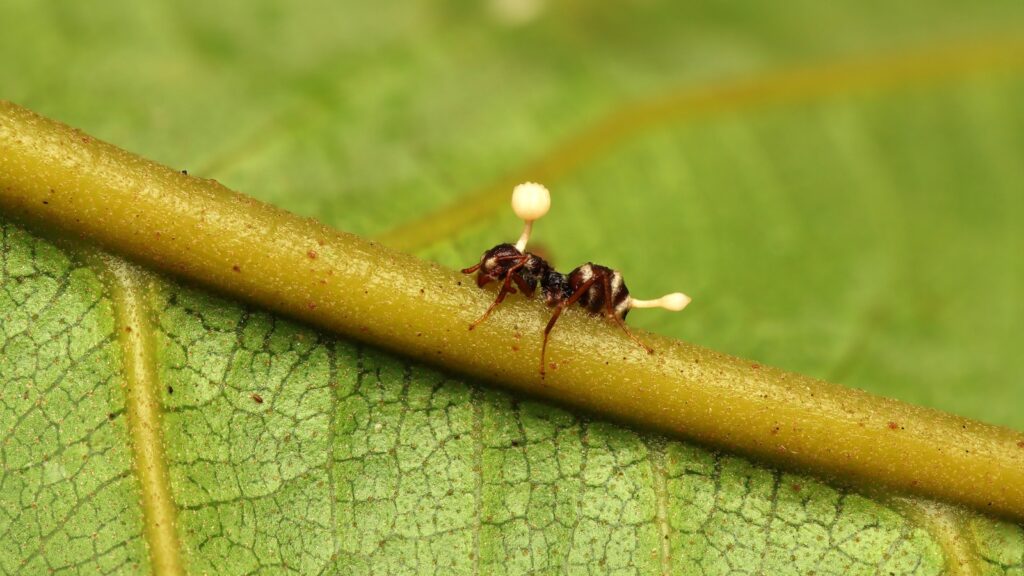
A dead ant with Cordyceps Fungi in Indonesian New Guinea.
Rezamonium/Shutterstock/ Rezamonium
The exploration stands for the oldest-known instances of parasitical fungis that contaminate bugs, the scientists claimed. Greater than 1,500 types of parasitical fungis are presently located in 5 of the 8 significant teams of fungis, according to the Natural History Museum in London.
O. unilateralis is recognized for contaminating the mind of its hosts and adjusting the bug’s habits– compeling it to look for much more desirable problems to make sure that the fungis can flourish, the scientists claimed. When the ant passes away, the fungi expands beyond its body and launches numerous spores to contaminate even more ants.
The Zombie-ant fungis was the property of the post-apocalyptic tv collection “The Last people.”
” This exploration reveals the effect of small microorganisms on social pets long prior to people advanced– with the soothing idea that these small microorganisms are not likely to leap to us, unlike in sci-fi movies!” Jarzembowski claimed.
The samplings are being housed at the Nanjing Institute of Geology and Palaeontology at the Chinese Academy of Sciences and Yunnan College.